
Criminal Cases in the Kinney County Courts
Texas assigns criminal jurisdiction by offense level. The Texas trial-court structure places felony cases in District Court. Kinney County felony matters go to the 63rd District Court. The constitutional Kinney County Court hears Class A and Class B misdemeanors because the county has no county court at law. Fine-only cases may belong in the Kinney Justice Court or, when venue lies inside the city, Brackettville Municipal Court. The court named on the citation, charging paper, or cause number is the best routing clue.
The combined County and District Clerk keeps both felony and Class A or B misdemeanor files, but acts in a different legal capacity for each court. The Justice of the Peace and municipal clerk maintain their own fine-only dockets. A court file begins with filed allegations, not the arrest record alone.
The official 63rd District Court page shows the court channel used for Kinney County settings.
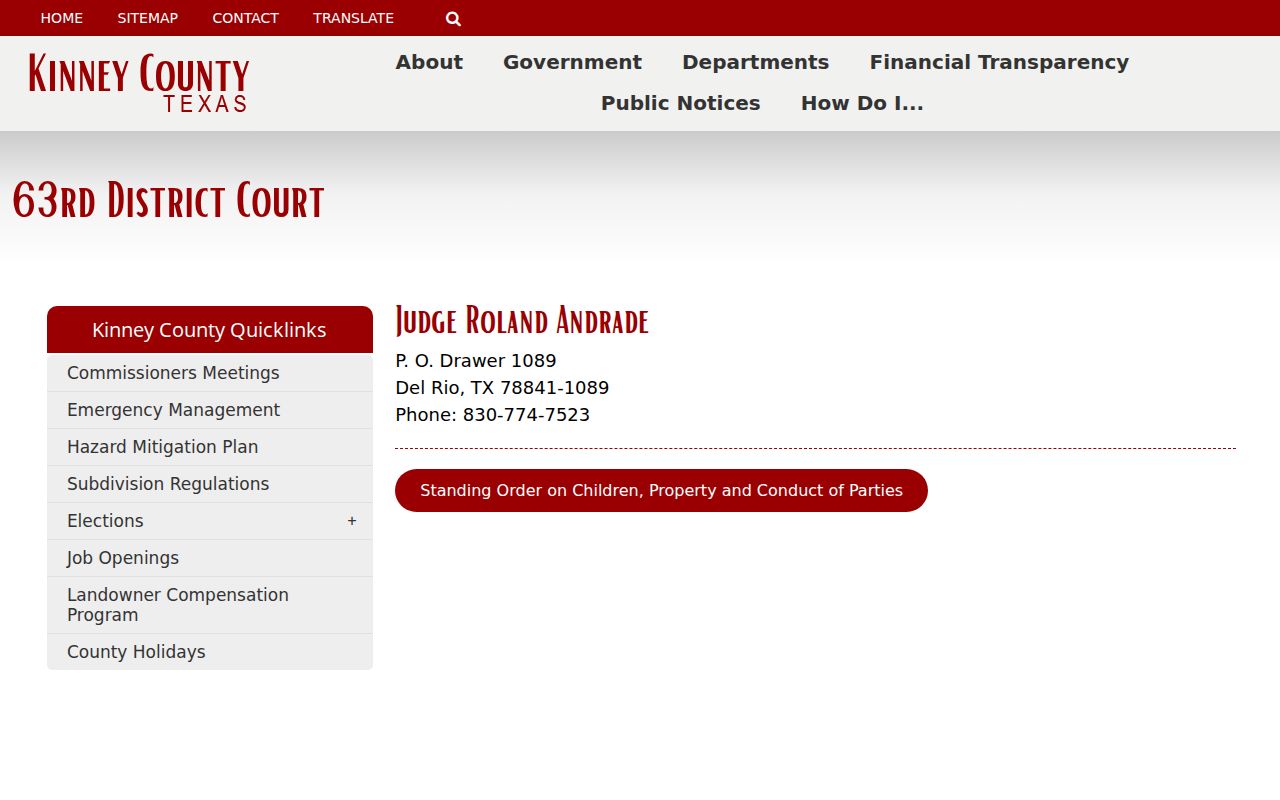
That local court page helps confirm the proper felony venue before a reader asks the clerk for a docket or certified judgment.
Kinney County Felony Court Files
The 63rd Judicial District covers Kinney, Edwards, Terrell, and Val Verde Counties. A Kinney County felony file remains with the Kinney District Clerk even though the judge's administrative office is in Del Rio. The District Clerk channel directs questions to the combined clerk at 501 S. Ann Street, P.O. Box 9, Brackettville, Texas 78832. Its phone is 830-563-2521 ext. 3, and its email is clerk.ralvarado@co.kinney.tx.us.
Use a cause number when known. Otherwise, give the name and approximate filing date, then ask whether the file is electronic, paper, or archived. Kinney County publishes no criminal name portal, full archive range, regular counter hours, or current copy and certification fee. The official felony-file clerk page identifies the local route.
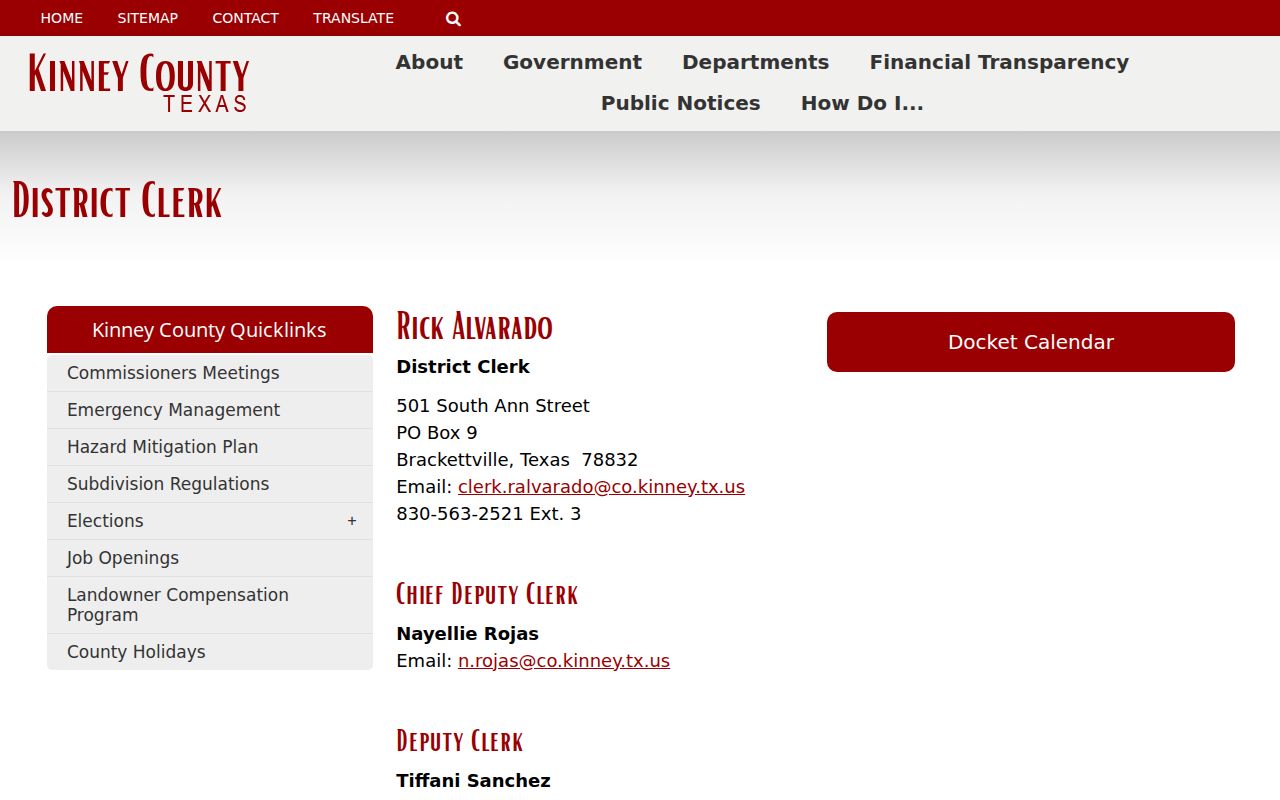
District administration spans four counties, but the Kinney clerk remains the starting point for local felony documents.
Note: A courthouse address does not establish counter hours, archive coverage, or a promised copy price; confirm each detail with the clerk.
How to Search Case Records
Kinney County has no person-name case database. The county homepage links misdemeanor dockets for current County Court settings, but a posted docket is a schedule, not a full index. The combined clerk is the local channel for felony and Class A or B files. The Justice of the Peace handles applicable fine-only county matters, while Brackettville City Hall can identify a municipal venue. re:SearchTX is supplemental and depends on e-filing, participation, access, and document availability.
- Identify the likely court from the offense level, citation, or charging paper.
- Check the posted misdemeanor docket or re:SearchTX, using a cause number when possible.
- Give the clerk a full name and approximate filing date if the cause number is unknown.
- Read the docket status and filed charge, then locate the judgment or final order.
- Request the exact pleading, docket sheet, judgment, or certified disposition from the proper clerk.
The likely re:SearchTX controls below come from the researched interface. Exact dropdown choices were access-gated and may change, so none is represented as a guaranteed Kinney search field.
| Field Label | Type | Required | Notes |
|---|---|---|---|
| Location or court | Select | Access-dependent | Narrow to the filing court when available |
| Case number | Text | No | Best identifier for a known Kinney filing |
| Party name | Text | No | Check spelling and possible name variants |
| Filed-date range | Date range | No | Helps separate similar names and older matters |
| Case type or status | Select | No | Live choices vary with access and court data |
| Result sorting | Control | No | Organizes results but does not expand coverage |
Note: Record the search date, since a new filing or disposition may reach the electronic layer after the clerk creates it.
Kinney County Misdemeanor Court Dockets
The county homepage's bilingual misdemeanor docket link is useful for current Kinney County Court settings. It should not be read as a database that proves every case tied to a person. A docket may show what is set for a court date, while a file can exist outside that posted slice. Searchers who need a complaint, information, order, or final judgment should contact the combined clerk in its County Clerk role. Class A and B misdemeanor cases belong there, not at the District Court felony desk.
The County Clerk page publishes check, credit-card, money-order, and cashier's-check payment methods, but it does not post the criminal copy price. Ask for a cost estimate and state whether a plain copy or a certified record is needed. Certification means the clerk attests that the copy is an official court record. It matters when the document will be used to correct a state criminal-history entry.
The official combined clerk source displays the contact and payment channel for misdemeanor records.
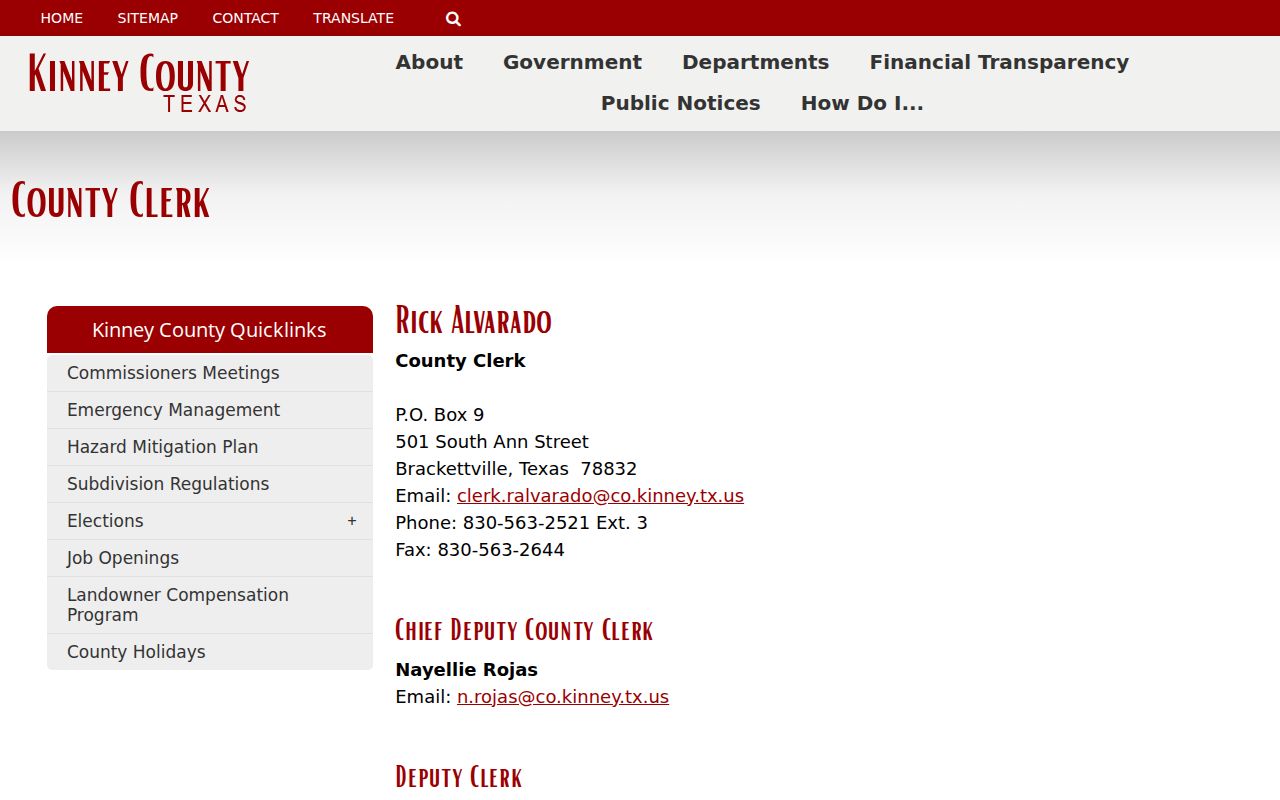
The image supports the local workflow: check the posted setting, then use the clerk for the case file and current copy terms.
What the Case File Shows
A Kinney County criminal case file records what the prosecutor filed and what the court did. It is more authoritative for the final charge and disposition than an arrest sheet or public DPS name result. The docket lists events in date order. The charging instrument states the filed accusation. Orders resolve motions or set duties, while the judgment and sentence show the outcome.
| Case Number & Court | Identifies the cause and the court with jurisdiction. |
|---|---|
| Charging Document | Shows the complaint, misdemeanor information, or felony indictment as filed. |
| Docket Entries | Lists filings, settings, motions, orders, and other case events by date. |
| Hearing Dates | Records scheduled or completed arraignments, pretrial settings, trial, and sentencing. |
| Disposition & Judgment | States whether the matter ended in conviction, dismissal, acquittal, deferred adjudication, or another result. |
| Sentence & Conditions | May state confinement, fine, community supervision, credit, and court-ordered terms. |
Restricted identifiers may not appear in public. Full Social Security numbers, complete birth dates, protected victim or minor information, and sealed material can be redacted. A link may also be absent when the docket event exists. Give its date and title when asking the clerk for access.
Kinney County Case Disposition Terms
A status word can change the meaning of an entire Kinney County court record. “Pending” means no final outcome appears yet. “Dismissed” means prosecution ended without a conviction on that charge, but it does not by itself erase the arrest or all related records. “Deferred adjudication” delays a finding of guilt while the person completes supervision. Successful completion can end in dismissal, yet public criminal-history reporting may remain unless legal relief applies.
Several less familiar docket terms are also decisive. They should be read with the signed order or judgment, not from a search-result label alone.
- No-bill
- The grand jury declined to return a felony indictment.
- True bill
- The grand jury returned an indictment.
- Acquitted
- The finder of fact returned a not-guilty result.
- Nolle prosequi
- The prosecutor formally declined or ended the prosecution.
- Disposition
- The recorded outcome of the charge or case.
The disposed charge may differ from the arrest allegation. Reduction, replacement, dismissal, plea, and trial can all change the record after booking. Compare the charging paper, docket, and judgment before drawing a conclusion from the first charge listed.
Stages of a Criminal Case
A Kinney County case file develops in stages. After arrest and magistration, the prosecutor decides what charge to file. A felony normally proceeds through grand-jury review and an indictment, while a misdemeanor may proceed by information. Arraignment is the formal plea stage. Discovery, motions, and settings follow. The case then reaches a plea, trial, dismissal, or other disposition, with sentencing after a conviction or deferred-adjudication order. The research does not support a fixed local duration for each stage, so no turnaround should be promised.
Case flow: Charges Filed → Arraignment → Pretrial → Plea or Trial → Disposition → Sentencing
The clerk's docket should mark each filed step, but a recent event can appear first at the courthouse and later in a state platform. Kinney district rules set docket call at 9 a.m. unless written notice states otherwise. They also limit removal of a set matter without a timely written continuance motion, agreement, dismissal, or final disposition. A calendar entry is still not the final judgment.
Note: An arrest charge may change before filing, so follow the cause number and signed court orders rather than the booking label.
Kinney County Court Search Limits
re:SearchTX is a statewide e-file and court-document access platform. It is not a complete statewide criminal-name repository, and it does not replace the Kinney clerk. Registration, access level, court participation, filing practices, and document charges can affect what a user sees. No private Kinney sample was inspected during research. That restraint matters because a blank result cannot prove that a case does not exist.
When an electronic search fails, contact the court custodian. Ask about name variations, filing date, cause number, paper or archive status, and documents that are docketed but not linked online. Older Kinney county and district records may also have historical microfilm through the Texas State Library, though current case access stays with the clerk. A search result is a locator; the filed court record controls.
The official state court-document platform shows the supplemental online route available to Kinney County record searchers.
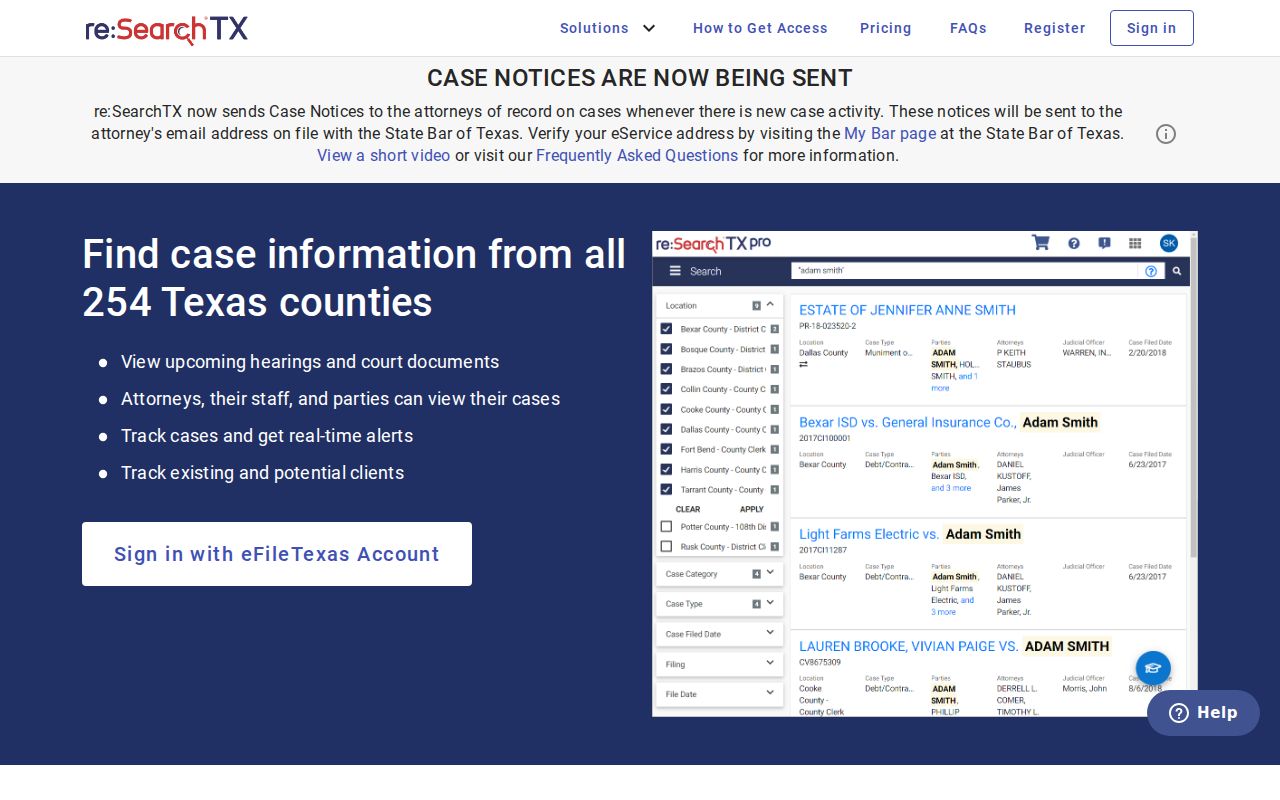
The interface can narrow a search, but local clerk confirmation remains essential when a file is missing, incomplete, or needed in certified form.
Access & Restrictions
Texas public-access law does not make every item in a criminal matter open. The Texas Public Information Act governs records held by governmental bodies, subject to exceptions, but filed judicial case records follow clerk and judicial-access routes. The county's central public-information email is not a substitute for requesting a pleading, docket sheet, judgment, or certified disposition from the clerk.
Juvenile files, sealed material, victim information, full identifiers, grand-jury deliberations, and some investigative material can be restricted. Texas Code of Criminal Procedure Chapter 55A controls expunction, while Government Code Chapter 411 covers nondisclosure. Expunction can remove covered records. Nondisclosure limits public access but preserves authorized access.
Online redaction can differ from courthouse access, and a docket may show an event without exposing its document. State the cause number and exact item sought. If the clerk denies access, ask whether the record is sealed, restricted, archived, or held by a different court. Do not route a fine-only Justice Court or municipal file to the felony clerk merely because the event occurred in Kinney County.
Kinney County Certified Court Dispositions
A certified disposition is the best Kinney County proof of how a filed charge ended. It should identify the court, cause, charge, outcome, and date. Texas DPS directs a person correcting a missing result to obtain one. An ordinary copy is not enough unless it carries the required embossed seal. Correction does not clear an accurate record.
Request the certified item from the clerk of the court that entered the result. For a felony, use the District Clerk capacity of the combined office. For a Class A or B misdemeanor, use its County Clerk capacity. The Kinney Justice Court is the direct source for its fine-only case records. Brackettville City Hall can identify the municipal route when the court channel is unclear.
Give the cause number, name, filing date, and exact judgment or disposition needed. Ask about certification cost and delivery because Kinney County posts no fee. Compare the result to the disputed state entry, then follow DPS Error Resolution. Correction and legal record relief are separate tasks.
Note: “Dismissed” describes a case outcome, but it does not automatically expunge the arrest, booking, or state reporting tied to the event.