
How to Check Criminal History in Kinney County
Start with the question the record must answer. Kinney County has no single criminal-history database. The sheriff can confirm recent local custody. The combined County and District Clerk routes filed misdemeanors and felonies. The Justice of the Peace or Brackettville City Hall may identify a fine-only venue. Texas DPS supplies a statewide public conviction and deferred-adjudication search, while fingerprint review is the sound route for checking your own fuller Texas record.
Use the full name, spelling variants, an approximate event date, and a cause, report, booking, or citation number when known. A date of birth can help an authorized office distinguish common names. Keep each answer tied to its source. A booking states an allegation and custody event. A clerk judgment states how a filed charge ended. A DPS entry reflects what participating agencies reported to the state.
- Call the Kinney County Sheriff at 830-563-2788 for recent custody and a booking identifier.
- Contact the combined clerk at 830-563-2521 ext. 3 for a felony or Class A or B misdemeanor case.
- Ask the Justice of the Peace or Brackettville City Hall about a fine-only case and its correct venue.
- Use Texas DPS for public statewide convictions and deferred adjudications, or FAST fingerprints for your own record.
- Order a certified disposition from the clerk when the final outcome must be verified or corrected.
The official Kinney County homepage shows the central public-information email and misdemeanor docket route. Its captured interface illustrates why the county lookup begins with routing rather than one search form.

The page points readers to county offices and posted dockets, but it does not provide a local person-name criminal record search.
Kinney County Clerk Record Split
One office serves as both County Clerk and District Clerk, yet the files remain legally distinct. The 63rd District Court hears Kinney County felonies. The constitutional County Court handles Class A and B misdemeanors. The clerk works at 501 S. Ann Street, Brackettville, Texas 78832, and also receives mail at P.O. Box 9. Contact the office at 830-563-2521 ext. 3 or clerk.ralvarado@co.kinney.tx.us. Checks, credit cards, and money orders or cashier's checks are listed payment methods, but no current criminal-copy or certification fee is posted.
Fine-only matters take a different path. The Kinney Justice of the Peace is at 207 E. Spring Street and keeps public hours from 8 a.m. to noon and 1 to 4 p.m. Brackettville may have concurrent municipal jurisdiction over city ordinance or Class C matters. Call before travel because general courthouse counter hours, archive coverage, and room numbers are not published.
re:SearchTX can supplement a Kinney County court inquiry with participating e-filed cases and documents. It is not a complete statewide criminal-name repository. Access level, local participation, and document availability can leave a Kinney County file out, so the combined clerk remains the source for the local docket and a certified disposition.
Combined County/District Clerk
501 S. Ann Street, P.O. Box 9
Brackettville, TX 78832
830-563-2521 ext. 3
Kinney Justice of the Peace
207 E. Spring Street, P.O. Drawer 389
Brackettville, TX 78832
830-563-2881
Official Texas Background Checks
The Texas Department of Public Safety Crime Records Division offers two different routes. Its public Conviction Name Search returns reported Texas convictions and deferred adjudications through name and Soundex matching. Each online credit costs $1. Card purchases add 2.25 percent per credit plus a $0.25 transaction charge, and a no-match search still uses a credit. The offline CR-42 name request costs $10 by check or U.S. money order. Neither route proves identity through fingerprints.
For self-review, DPS FAST uses fingerprints captured through IdentoGO. DPS publishes a $15 record-check component and a $10 electronic fingerprinting component. No enrollment center was confirmed inside Kinney County, so travel may be needed. DPS states about ten business days after receipt, apart from postal time. An FBI Identity History Summary is also subject-only and fingerprint-based; it costs $18 and covers fingerprint submissions associated with the subject across participating jurisdictions.
| Official route | Best use | Published cost |
|---|---|---|
| DPS online name search | Public Texas convictions and deferred adjudications | $1 credit, plus card charges |
| DPS CR-42 by mail | Offline public name request | $10 |
| DPS FAST personal review | Your fingerprint-linked Texas record | $15 check plus $10 capture |
| FBI Identity History Summary | Your interstate federal identity summary | $18 plus possible print fee |
Kinney County DPS Search Limits
The Texas DPS Conviction Name Search broadens queries through several name combinations and similar-sounding spellings. A preview may show descriptive match details before a full record is opened. Search history records what was searched, not necessarily the returned report, so save or print an opened result when needed. A broad result can be useful, but DPS warns that fingerprints are the only positive link to an identity.
| Search element | Use | Kinney County caution |
|---|---|---|
| Account | Required before public searching | Credits are prepaid |
| Name | Exact and Soundex combinations | Possible matches are not identity proof |
| Date of birth | Narrows a query | Compare only lawfully displayed data |
| Preview | Reviews descriptive match information | Does not replace the court file |
| No match | Reports no returned match | Still costs the first credit |
The official DPS interface shown below is the state name-search route assigned to Kinney County criminal history research.
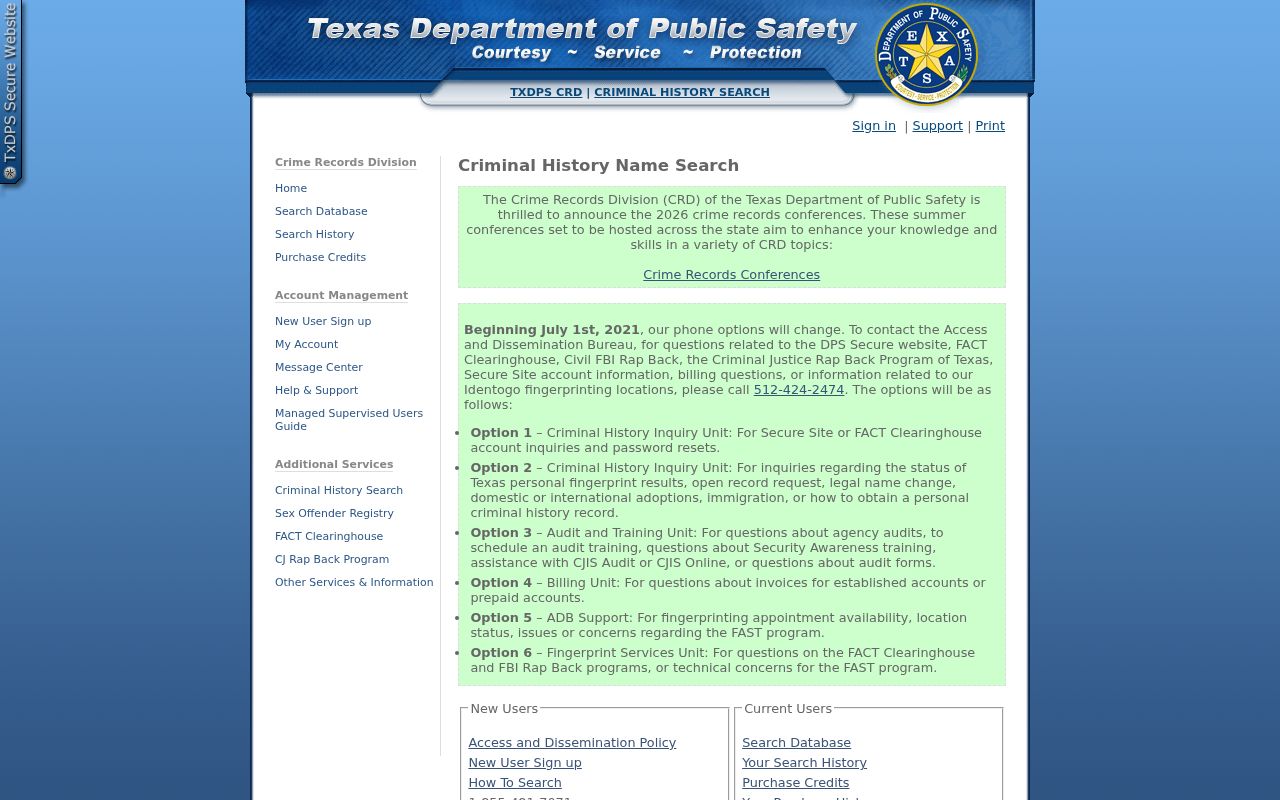
A dismissed local case may appear in a clerk docket yet be absent from this public conviction product. The reverse can occur when DPS returns a reportable case from another Texas county.
Note: A $1 DPS search is not a full rap sheet, a certified Kinney County judgment, or a fingerprint-confirmed identity check.
Types of Criminal Records
Each stage creates its own record. An investigating agency writes an incident or offense report. An arrest record describes the custody action and its legal basis. The receiving facility makes a booking record. Prosecutors and courts create complaints, informations, indictments, dockets, orders, judgments, and sentences. DPS then assembles reportable arrest, prosecution, disposition, and custody transactions in Computerized Criminal History.
Other Kinney County records answer narrower questions. The issuing court and executing agency share the warrant trail. A sentencing judgment shows community supervision, which Texas uses for probation, while detailed supervision files are not ordinary public dockets. TDCJ and the Board of Pardons and Paroles supply the prison and parole layers. The Texas Public Sex Offender Registry publishes only the statutory public fields of a separate registration record.
- Agency report: narrative, original allegations, witnesses, evidence, and attachments, subject to redaction.
- Booking record: intake identifiers, charges, bond, holds, custody status, and release data that may be releasable.
- Court file: cause number, filed charge, settings, motions, orders, disposition, judgment, and sentence.
- State history: transactions reported to DPS, with a narrow public subset and broader personal fingerprint review.
- Custody record: county jail for local detention, TDCJ after state transfer, or BOP for federal custody.
- Disposition
- The outcome of a filed case, such as conviction, dismissal, acquittal, or deferred adjudication.
- No-bill
- A grand jury decision not to return an indictment.
- Nondisclosure
- A Texas order limiting public access while leaving access for authorized recipients.
- Expunction
- A court-ordered removal or destruction of eligible records under Texas law.
Kinney County Jail Records Without Roster
Kinney County publishes no official jail roster, booking log, inmate profile, warrant list, separate inmate line, or local search portal. Call the Sheriff and jail contact at 109 North Street, Brackettville, 830-563-2788. Ask for present custody, the booking identifier, bond or release status, and the arresting agency. Counter hours are not posted. Confirm the preferred delivery method before submitting a copy request.
A warrant check also needs more than a failed web search. Call the sheriff and the likely issuing court, then route a county or district case to the combined clerk, a fine-only county matter to the Justice of the Peace, or a possible Brackettville matter through City Hall. Ask for the warrant type, issuing court, cause or citation number, charge, bond, and required resolution method. Do not assume payment alone clears a warrant.
Texas replaced VINE with IVSS-Counties on September 1, 2025, although the sheriff page still carries an older VINELink link. The Texas Attorney General's current IVSS guidance describes free custody searches and alerts for booking, release, court changes, death, escape, and transfer into TDCJ. Participation may vary. Verify urgent facts and negative results with the sheriff.
After a state sentence and transfer, use TDCJ Offender Information. A federal border case may instead appear in PACER and the BOP Inmate Locator. Absence from one layer does not rule out custody in another.
For Kinney County sheriff reports or booking copies, the office also publishes P.O. Box 1200 and fax 830-563-9144. County agency requests may go to publicinformation@co.kinney.tx.us. Name the event date, place, arresting agency, report or booking number, and the exact components sought. Ask for electronic delivery and an estimate because no local fee or turnaround is posted.
What a Kinney County Criminal Record Shows
A Texas CCH entry may carry a SID or FBI number, primary name and aliases, date of birth, physical descriptors, arrest date and agency, tracking number, offense code and class, prosecutor action, court cause number, disposition, sentence, and later custody updates. The local clerk file goes deeper into pleadings, hearings, financial entries, orders, and the certified disposition.
| Identity | Name, aliases, birth data, sex, race, and physical descriptors, subject to access rules. |
|---|---|
| Arrest cycle | Agency, date, incident or tracking number, and original reported charge. |
| Court action | Court, cause number, filed or disposed charge, and outcome date. |
| Sentence | Confinement, fine, community supervision, and related terms reported to DPS. |
| Custody | Later incarceration or supervision transactions when reported. |
Names can falsely match. Compare the jurisdiction, dates, physical description, and the authoritative case file. Use fingerprints when reviewing your own record and a certified clerk copy when a final Kinney County outcome matters.
Kinney County Highway 90 Record Trail
A Highway 90 event can split across several custodians. A Texas DPS trooper report stays with DPS even if the sheriff receives the person. Sheriff intake creates a separate booking file. The combined clerk later holds any Kinney County prosecution, while a federal border matter belongs in the Western District of Texas. That division explains why asking one office for every document often fails.
Crash reports take another route. Use the TxDOT CRIS purchase system with the crash date, location, involved party, or report identifier. The current purchase amount was not verified in accessible official material, so confirm it in the portal instead of relying on an old fee.
The assigned capture comes from the official TxDOT CRIS interface used for this Kinney County record channel.
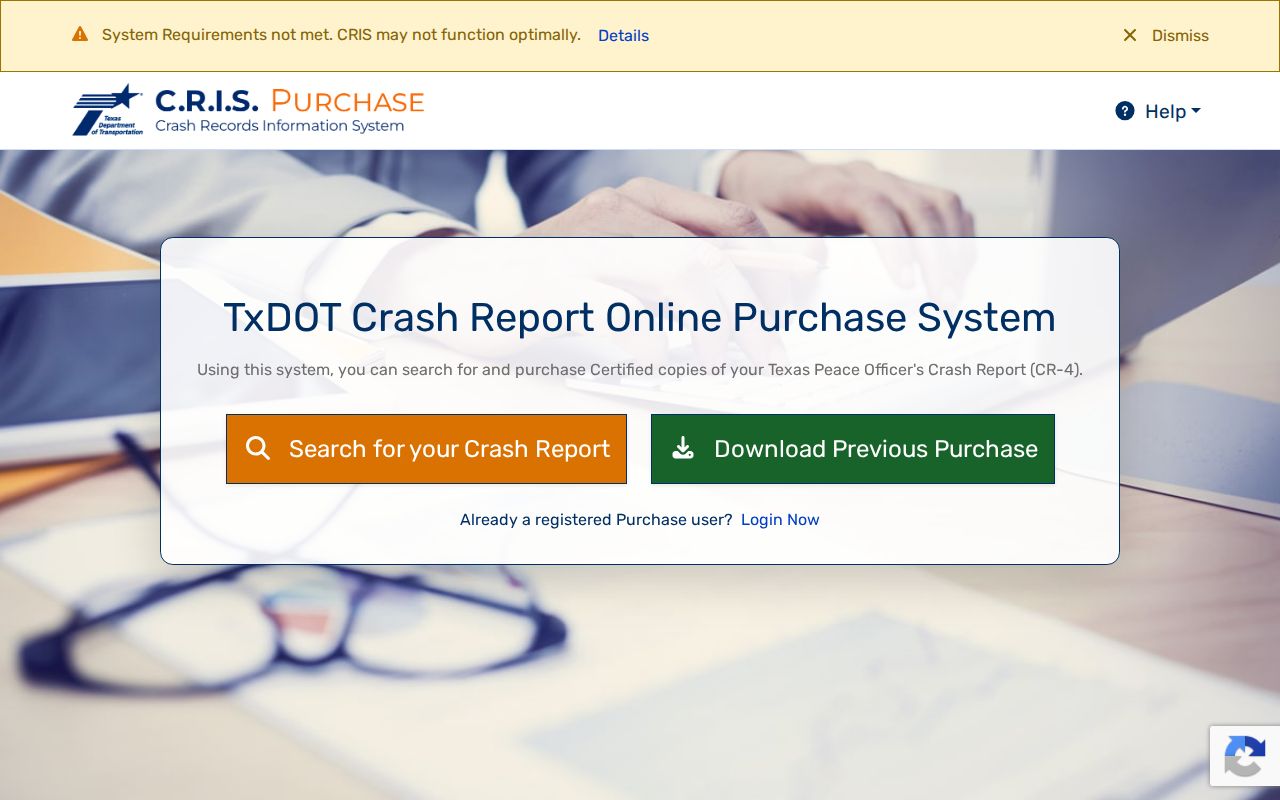
CRIS answers a crash-document request. It does not replace the arresting agency report, sheriff booking record, or court disposition.
Public Access Laws
The Texas Public Information Act permits access to government records subject to exceptions, but filed judicial case records normally go through the clerk. Criminal-history laws separately control what DPS may release. Juvenile sealing, victim privacy, active-investigation exceptions, expunction, nondisclosure, sealed warrants, and court orders can limit access. Public availability never removes the need to verify identity and outcome.
Government Code Chapter 552 sets the public-information framework and its exceptions.
Government Code Chapter 411 makes specified conviction and deferred-adjudication history public while protecting other CHRI.
Code of Criminal Procedure Chapter 66 defines the reporters and transactions feeding state history.
Code of Criminal Procedure Chapter 55A governs expunction eligibility and procedure.
For a sheriff or county-agency document, email publicinformation@co.kinney.tx.us with the agency, date, location, known identifier, exact items sought, preferred electronic delivery, and a request for a cost estimate. Send filed pleadings and judgments to the clerk instead.
Police and incident reports stay with the agency that created them. A Kinney County sheriff or constable report follows the county request route, while a Highway 90 trooper report belongs to DPS. Registry questions use the Texas Public Sex Offender Registry, including its KINNEY county filter and Unmapped category. Use the dedicated registry channel for address, name, ZIP, school, and county searches rather than treating a court or jail lookup as a substitute.
Kinney County Courthouse Record History
The current courthouse is part of the county's record story. Kinney organized in 1873 after officials had met in a private home and a commercial building. A purpose-built courthouse followed in 1879. The present buff-brick building was first occupied in 1911. L. L. Thurmon and Co. designed its Beaux Arts Classical plan, with red-brick bands, octagonal corner towers, columned entries, and a central Seth Thomas clock tower.
The building became a Recorded Texas Historic Landmark in 2003 and entered the National Register in 2004. The combined clerk still works there, so old and current court records share a physical center in Brackettville. Historical Kinney County and district microfilm also exists through the Texas State Library, including county minutes beginning in 1876.
The Texas Historical Commission record provides the official courthouse history and photograph.
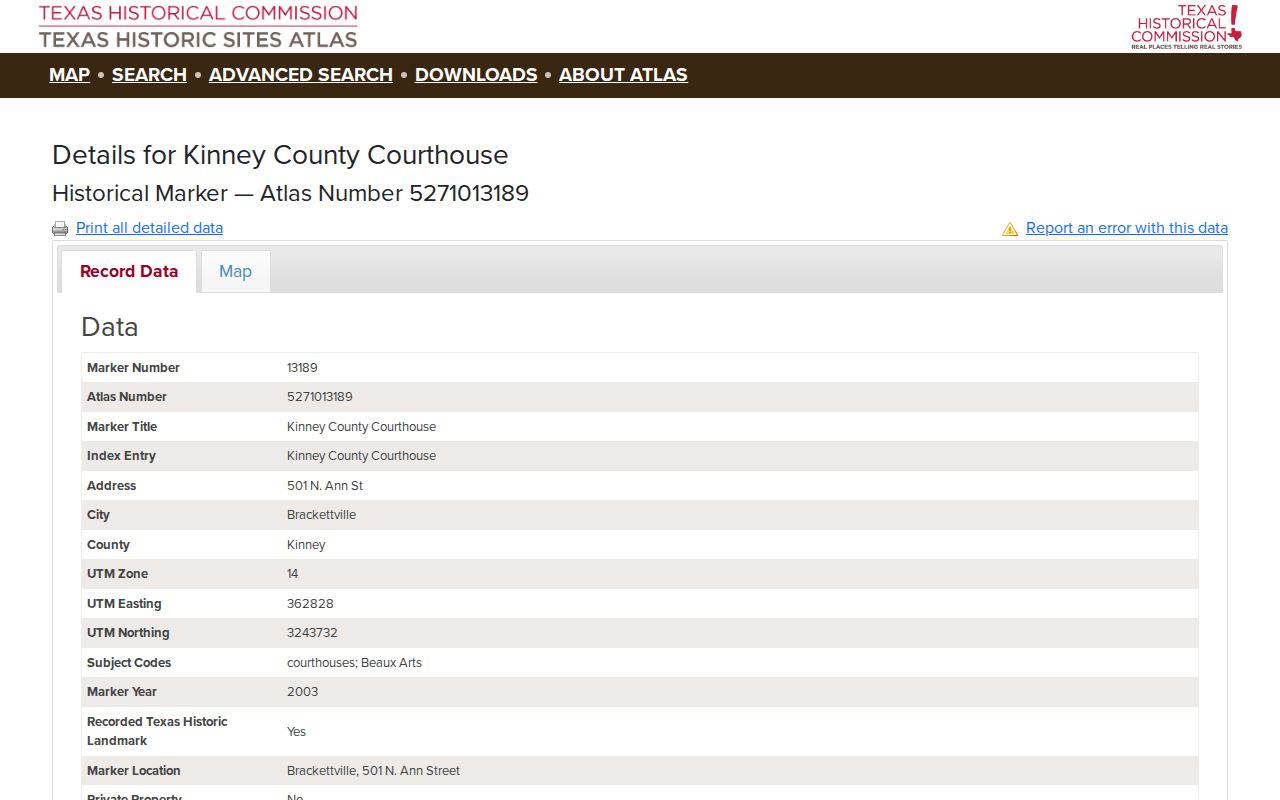
The image shows the local building where felony and misdemeanor records are routed through the clerk's two legal capacities.
Sealed, Expunged & Restricted
Texas moved expunction law into Chapter 55A in 2025. Possible grounds include acquittal or pardon, qualifying release without final conviction, mistaken identity, and certain prosecutor-filed applications. General release-based waits are 180 days for a Class C arrest, one year for Class A or B, and three years for a felony, unless the prosecutor supplies the statutory certification. Eligibility turns on the whole arrest event, later charging, prior history, limitations, and supervision.
Nondisclosure is different. It limits public CHRI while preserving access for criminal-justice and other named recipients. Completed deferred adjudication often points toward nondisclosure, while an acquittal, pardon, no-bill, or qualifying release may support expunction. Kinney County posts no petition form, filing fee, or completion time. Confirm the current process with the District Clerk and do not borrow another county's fee.
The Texas courts publish state model nondisclosure forms for several statutory routes.

Model forms help identify a possible route, but they do not decide whether a specific Kinney County arrest or case qualifies.
Kinney County Record Correction
A correct court outcome can be missing from DPS because it was never reported, was rejected, or still lags at the reporting agency. Obtain a certified disposition from the court of jurisdiction. DPS says an ordinary photocopy is not enough unless it bears the embossed seal. Send the proof to the Error Resolution Unit, P.O. Box 4143, Austin, TX 78765-4143, fax 512-424-5577, or error.resolution@dps.texas.gov.
Correction and clearing are separate acts. Error resolution fixes inaccurate or incomplete reporting. Expunction or nondisclosure limits an accurate record only when a court grants relief. After an order, check both the local clerk channel and a personal fingerprint review. The DPS error-resolution instructions describe the state correction route.
Criminal Records by City in Kinney County
Official Census incorporated-place records identify only two cities. Brackettville is the county seat and has City Hall and a named municipal judge, but no published police records portal or municipal case search. Spofford has no verified city website, police channel, court portal, or holding facility. Its record path starts with county offices.
Brackettville Criminal History
2020 population 1,341. City Hall can help identify fine-only venue; sheriff and clerk hold the main criminal record paths.
Spofford Criminal History
2020 population 41. No municipal portal is published, so searches route through Kinney County and Texas agencies.
Kinney County Crime Record Context
The 2020 Census counted 3,129 Kinney County residents across 1,360.53 land square miles. Sparse geography makes phone and email fallbacks more than a convenience. Most local counters cluster in Brackettville, while the district judge and district attorney keep administrative offices in Del Rio. Confirm venue and counter access before a trip.
Texas DPS's 2024 border crime report lists the Kinney Sheriff with all 12 months reporting, 11 total listed offenses, eight clearances, and seven arrests. Those numbers cover the report's defined sheriff data. They are not every border encounter, prosecution, federal case, or city crime count. Small denominators also make year-to-year rates volatile.
Read the figure as scope, not as a shortcut to one person's history. Individual research still moves from agency event to booking, filed case, disposition, and any later custody record. That chain is the reliable Kinney County method.